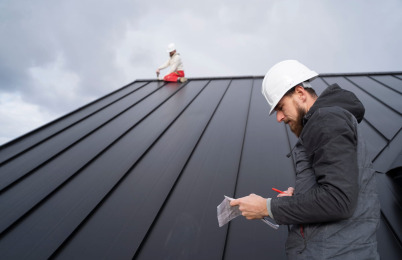



Roof Replacement and Repair in Colorado Springs
A full asphalt shingle roof replacement on a typical Colorado Springs home takes one day and generally runs $650 to $850 per 100 square feet of roof area, putting most homes between $12,000 and $25,000. Seamless Choice has worked on exteriors across El Paso County since 2014, including close to 1,000 insurance claims, and we now handle roofing on the same terms: licensed, permitted, documented, and inspected.
What we handle
We are actively working with property managers, realtors, and home inspectors who need a straight answer on a roof’s condition rather than a sales pitch.
- Full tear-off and replacement
- Roof repair
- Storm and hail damage restoration
- Insurance claim work, including supplements
- Solar panel remove and reset
- Decking repair and replacement
- Vents, flashing, and drip edge
- Gutters, soffit, and fascia
Roofing materials we install
| Material | Best for | Notes |
|---|---|---|
| Architectural asphalt shingles | Most Colorado Springs homes | The standard replacement. Fast install, wide color range. |
| Class 4 impact-resistant shingles | Hail-prone areas | Rated to UL 2218 Class 4, the highest impact classification. |
| Standing seam metal | Longevity, snow shedding | Higher cost, very long service life. |
| Stone-coated steel | Metal durability, traditional look | Reads like shingle or tile from the ground. |
| Synthetic slate | Slate appearance without the weight | No structural reinforcement required. |
A straight answer on Class 4 shingles
Colorado law does not require insurers to discount premiums for impact-resistant roofs. Many carriers do offer a discount voluntarily, and the amount varies widely between companies. Ask your agent what your specific carrier offers before you assume a number — the payback math changes completely depending on the answer.
Class 4 impact-resistant shingles are worth considering in this market, but the case for them is often oversold.
What Class 4 reliably does is resist hail damage better than standard architectural shingle. Whether the premium credit alone pays for the upgrade depends on your carrier, your roof size, and how long you plan to stay in the house. We will run that math with you honestly, including the cases where it does not pay off.
What a free roof inspection actually involves
There is no cost and no obligation.
Ground check. We start from the ground — gutters and roof edges for loose components, sagging lines, and shingle granules that have washed off the roof.
On-roof check. We walk the surface and inspect decking, shingles, metal flashing around chimneys, and vent seals. Every area of existing damage is photographed, whether it is hail bruising or ordinary age. If there are solar panels, they are inspected for storm damage too.
Aerial survey. On roofs with hard-to-reach areas such as roofs with very steep pitch, we use a drone.
Final report. You receive the photos, an assessment of the roof’s overall condition, and an estimate for repair or replacement if either is needed.
Sometimes the answer is that your roof is fine
A realtor once asked us to inspect a roof before a sale, expecting to negotiate over it. We told him the roof was in good shape and needed no work. That was a considerable relief to the homeowner, and it cost us the job.
We would rather give you that answer than sell you a roof you do not need. If your roof has years left in it, we will tell you, and we will tell you roughly how many.
Hail damage and insurance claims
We have worked on nearly 1,000 exterior insurance claims since 2014. The heaviest years were 2016, 2017, 2018, 2020 and 2021, but there is covered storm damage in this region every year.
The first estimate from your insurer is always incomplete
That is not an accusation of bad faith. It is a structural fact of how claims are written.
Permit fees are missing from every claim we see. Insurance estimating software cannot price a local permit, so it does not include one. The fee is a legitimate part of the cost of restoring your roof to code.
Beyond the permit, first estimates routinely omit code-required items: ice and water shield where the address requires it, ventilation, gutters, and proper disposal of the old material. On the siding side, we regularly see missing vapor barrier, misclassified siding grade, missing low voltage wiring, and no allowance for moving the homeowner’s belongings.
We take the claim over from there and file the supplement. If you want us to meet your adjuster on site, we will.
Two claims worth describing
The discontinued siding. An insurer approved a full roof replacement but only about 252 square feet of vinyl siding. We obtained an ITEL report establishing that the homeowner’s siding had been discontinued and could not be matched. The carrier approved siding for the entire house and the garage, and we added the code-required items that had been left out. The homeowner got a complete exterior instead of a patch.
The WUI upgrade. On a property in a Wildland-Urban Interface zone, we had the carrier upgrade the approved scope from vinyl to James Hardie fiber cement, because non-combustible cladding is what that zone requires.
Neither outcome happens automatically. Both required somebody to read the estimate against the code and push back.
Hail does not stop at the roofline
This is the part most homeowners find out too late.
The same hail that bruises your shingles dents siding, fascia, and gutters. But adjusters frequently write the roof and miss the walls — partly because the roof is the obvious damage, and partly because a roofing contractor inspecting your property is looking at the roof.
We have replaced siding on El Paso County homes since 2014 and we replace roofs. When we inspect after a storm, we inspect the entire exterior, and we document all of it for your insurer in one claim. There is a further wrinkle inside the Colorado Springs Wildland Urban Interface. As of June 30, 2026, under Appendix K of the city’s fire code, a home in the WUI that receives 25% or more replacement of its exterior cladding has to be rebuilt with ignition-resistant materials. The previous threshold was 50%, so it now takes half as much damage to trigger it. A hail claim that crosses that line is no longer a like-for-like siding replacement — the material has to change, and that belongs in the claim from the start rather than surfacing after the scope is approved.
A roofing-only company cannot make that argument. Neither can a siding-only company. It is the specific reason we added roofing rather than staying in one trade.
What a roof replacement costs in Colorado Springs
Most residential roof replacements in this area fall between $12,000 and $25,000. The working number is $650 to $850 per 100 square feet of roof area.
What moves you within that range:
Pitch. Roofs at 8:12 and steeper get progressively more expensive as the pitch increases.
- Complexity. Ridges, valleys, and hips are not expensive in themselves, but they slow the work down and increase material waste.
- Decking repair. Roughly $100 to $125 per 4×8 sheet of OSB that has to be replaced. This is not knowable until the old roof is off.
- Existing layers. Each additional layer of old roofing adds about $35 to $40 per 100 square feet to remove.
- Cedar shake. If the existing roof is cedar shake, add approximately $50 per 100 square feet.
- Solar panels. $300 to $450 per panel to remove and reset, depending on roof complexity. Solar removal requires its own permit.
We give you a written estimate after the inspection, and the decking allowance is stated up front so there is no surprise once the tear-off starts.
If you are paying out of pocket rather than through an insurance claim, financing options are available, including a 12-month no-payments, no-interest plan.
The code requirements depend on your address
Roofing code in this region is not uniform. It changes by jurisdiction and sometimes by elevation, and one of the more expensive line items — ice barrier — varies more than almost anything else.
El Paso County (PPRBD). Ice barrier is required only on properties above 7,000 feet in elevation, running from the eave edge to at least 24 inches inside the exterior wall line. Below 7,000 feet it is not a code requirement. Your property’s elevation is printed on the permit receipt.
Pueblo (PRBD). Ice barrier is not required. The department’s own re-roofing guide states this directly.
Douglas County. Unincorporated Douglas County requires it above 7,000 feet. Municipalities differ significantly — Castle Rock requires it on essentially all roofs, while Lone Tree and Castle Pines do not. Parker and Larkspur have to be confirmed with the building department directly.
This is close to address-specific, and it is one of the clearest reasons to hire a contractor who pulls the permit and knows the jurisdiction. A crew that does not know which side of 7,000 feet your house sits on is guessing with your money.
If you are in the Wildland Urban Interface
Homes inside the Colorado Springs WUI carry clearance rules that most homeowners have never been told about, and they apply to the area around your roof. Colorado Springs Wildland Urban Interface
Tree branches, other than character trees and deciduous trees, are not permitted to extend over or under the roof or eaves, and must stay at least 15 feet from a chimney or wood-burning appliance. Conifers and similarly combustible plants cannot be planted under soffit vents. Hazardous brush and trees such as junipers and conifers are not allowed within 15 feet of the structure, measured from the drip line of the tree.
It is worth knowing because it is enforced, and because a contractor who has never mentioned the WUI to you probably has not checked whether your address is in it. You can look your address up on the Fire Department’s WUI map, linked from coswildfireready.org.
Solar panels
If you have solar, the roof replacement gets more involved, and this is where we do something most roofing companies do not.
Before the panels come off, we test them and document their performance. After the roof is finished and the panels are reset, we test them again and confirm they are performing as they were before the work started. You receive that documentation.
Solar removal and reset requires its own permit, pulled by a licensed contractor. Budget $300 to $450 per panel depending on the complexity of the roof.
The reason for testing before and after is straightforward: if a panel fails six months later, nobody can establish whether the roof work caused it. The report settles that question in advance.
What happens on install day
A typical residential asphalt shingle roof is a one-day job with a six to seven person crew.
Our production manager supervises the installation. He has many years of experience across a wide range of roof types, residential and commercial. He takes progress photographs throughout, and he is the person responsible for catching anything that could not be seen from the ground during the inspection — rotted decking, previous repairs done badly, damage hidden under the old shingles.
When the roof is done:
- Every nail, old and new, is picked up with a magnet
- Gutters are cleared of granules, shingle fragments, nails, and debris
- Old roofing material goes to a recycling facility
- Landscaping is protected during the work and is normally unaffected
You get one point of contact who is on your roof, not a salesperson who hands you off after the contract is signed.
Licensed where we work
| Jurisdiction | License / Registration |
|---|---|
| El Paso County (PPRBD) | 21165 |
| Douglas County | C140280 |
| Pueblo County (PRBD) | CLR-26-414 |
| Elbert County | 26EC-RO-2600 |
| Town of Castle Rock | CR26-0308 |
We pull the permit on every job. You can verify any of these with the issuing department before you sign anything, and we would encourage you to — with us or with anyone else you are considering.
You can also read what our customers say — a 5.0 rating across 260+ Google reviews.
Warranty: 10-year workmanship warranty on our roofing installations, in addition to the manufacturer’s warranty on the materials themselves.
Why you should not hire the person who knocks on your door
We have met multiple homeowners in this region who lost money to a storm chaser. Here is what they have told us.
Fake local identity. Business cards printed to look like a local company. They take a deposit and are never seen again.
No license, no permit. Many are not licensed and do not pull permits. If someone is injured on your roof — or claims they were — you can be personally liable for their medical bills and lost wages.
Ask you to pull the permit yourself. This is the clearest red flag there is. If the permit is in your name, you are the party responsible for code compliance, not the contractor. A licensed contractor pulls the permit. Someone asking you to pull it is telling you they cannot.
No warranty in practice. A company from out of state is not driving back to Colorado Springs to look at your roof in year three.
The rule is simple: if a roofing company knocked on your door, do not hire them. Tell them you have already engaged a contractor and you do not need a free inspection.
Find companies yourself and contact them first. That way you know you initiated the conversation and the company is real. Then ask three questions:
- Will you pull the permit?
- What is your labor warranty, in writing?
- Who is the specific person running my project, and will they be on site?
Where we work
El Paso County, Douglas County, Pueblo County, and Elbert County, plus Woodland Park in Teller County.
That includes Colorado Springs, Fountain, Security-Widefield, Monument, Palmer Lake, Falcon, Peyton, Black Forest, Manitou Springs, Woodland Park, Castle Rock, Larkspur, Pueblo, Pueblo West, and Elizabeth.
Common questions
How long does a roof replacement take?
A typical residential asphalt shingle roof is one day with a six to seven person crew. Larger or more complex roofs take longer, and we tell you which yours is before we start.
Do I need to be home?
No, though most people are. You will have direct contact for the person running your project either way.
Will you meet my insurance adjuster?
Yes, if you want us there. Many homeowners prefer it, because that is the conversation where scope gets decided.
My insurance estimate seems low. Is that normal?
Yes, and it is usually incomplete rather than wrong. Permit fees are missing from essentially every first estimate we see, and code-required items are frequently left out. We file the supplement.
Do you offer free roof inspections?
Yes, with no cost and no obligation.
Is ice and water shield required on my roof?
It depends on your address. In El Paso County it is required above 7,000 feet of elevation. In Pueblo it is not required at all. In Douglas County it varies by municipality. We confirm your jurisdiction’s requirement before we quote.
What happens if you find rotted decking?
We replace it and charge roughly $100 to $125 per 4×8 sheet. The allowance is stated in your estimate up front, because nobody can see under the shingles until the tear-off starts.
Do you work on apartment buildings and HOA properties?
Yes. We actively take multi-family roofing work and we work with property managers and HOA boards.
Do you do roof repairs, or only replacements?
Both.
Get a free roof inspection
No cost, no obligation. Photos of every slope, an honest read on how much life is left in your roof, and a written estimate only if you need one.